Method Determines Theology, Part 2
How Historical Criticism Reshaped Biblical Interpretation and Why It Matters Today

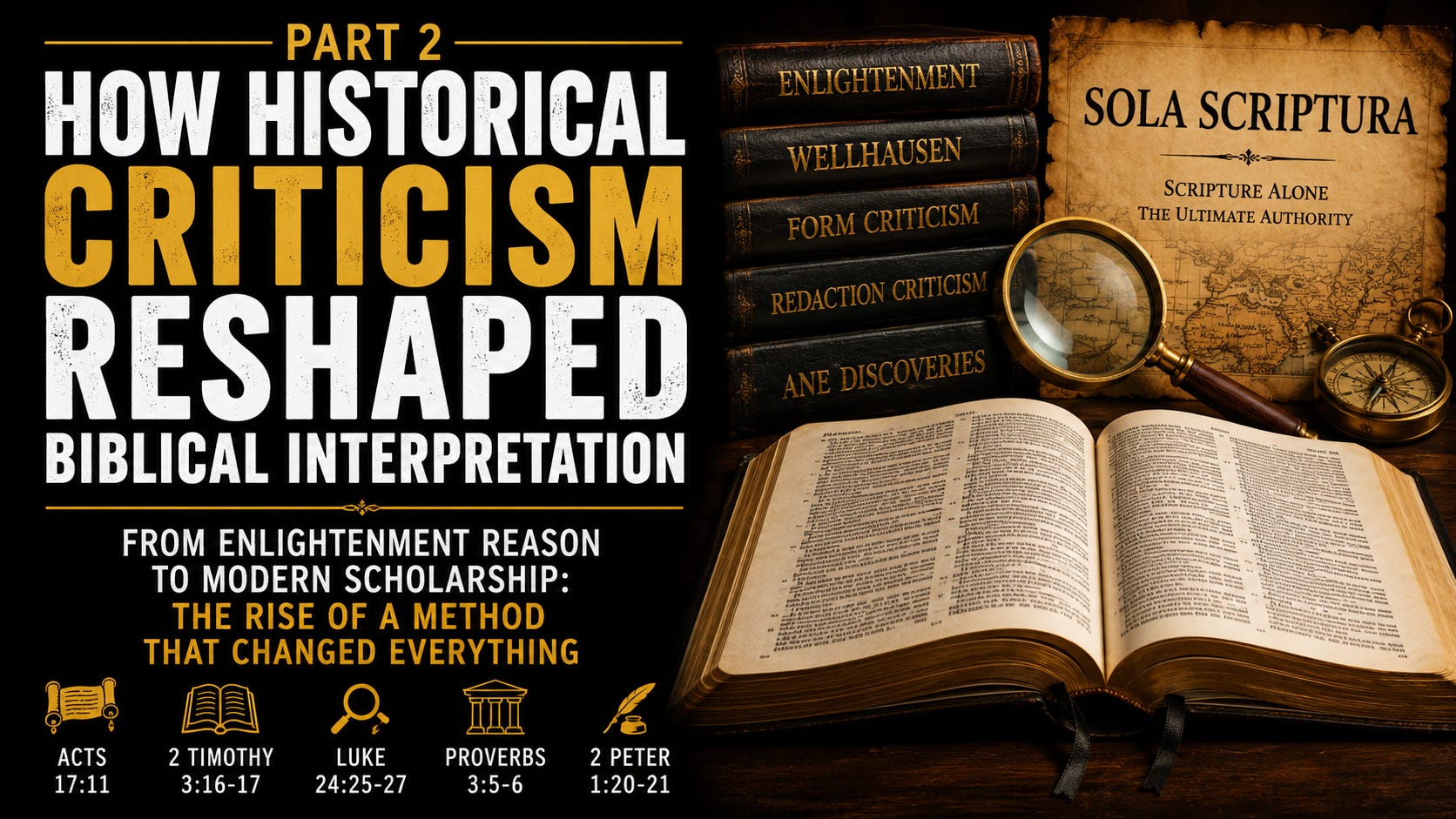
In Part 1, we established that every theological system rests upon a hermeneutical foundation. Before Christians disagree about creation, eschatology, Israel, the church, or ethics, they have already adopted a method of interpretation that governs how they read Scripture. We also corrected a common misconception about historic fundamentalism. Contrary to popular caricature, historic fundamentalism was never opposed to historical research, archaeology, or literary study. Its central concern was that Scripture, because it is the inspired Word of God, must remain the supreme authority in interpretation.
This raises an important historical question. If the grammatical-historical method has characterized biblical interpretation for centuries, how did modern biblical scholarship arrive at a place where reconstructed ancient culture often appears to govern the interpretation of Scripture? The answer lies in the rise of historical criticism.
The intellectual movement known as the Enlightenment dramatically altered Western approaches to knowledge. During the seventeenth and eighteenth centuries, confidence in autonomous human reason increasingly displaced confidence in divine revelation. Thinkers such as René Descartes, Baruch Spinoza, David Hume, and Immanuel Kant each contributed, in different ways, to a cultural climate in which reason became the ultimate court of appeal. Rather than beginning with God’s revelation and allowing reason to function ministerially, many Enlightenment thinkers reversed the order. Human reason became magisterial, sitting in judgment over every claim—including the claims of Scripture.
This shift profoundly affected biblical interpretation. Instead of asking, “What has God spoken?” scholars increasingly asked, “What can modern historical investigation verify?” Miracles were viewed with suspicion because they violated assumptions about the regularity of nature. Predictive prophecy was questioned because it implied supernatural revelation. The Bible increasingly came to be studied as one ancient religious text among many rather than as the uniquely inspired Word of God.
No figure better illustrates this transition than Friedrich Schleiermacher (1768–1834), often called the father of modern liberal theology. Rejecting traditional Protestant emphasis on divine revelation, Schleiermacher grounded religion primarily in human religious consciousness or the “feeling of absolute dependence.” Theology increasingly became the study of religious experience rather than God’s objective self-disclosure in Scripture. Although Schleiermacher did not invent historical criticism, his influence encouraged interpreters to relocate authority from revelation to human experience.1
Later in the nineteenth century, Julius Wellhausen (1844–1918) transformed Old Testament scholarship through what became known as the Documentary Hypothesis. Building upon earlier source-critical proposals, Wellhausen argued that the Pentateuch was not substantially authored by Moses but was instead compiled from four major documentary sources commonly designated J (Yahwist), E (Elohist), D (Deuteronomist), and P (Priestly). According to this theory, Israel’s religion gradually evolved from primitive tribal beliefs into sophisticated priestly monotheism.2
The implications extended far beyond questions of authorship. If the Pentateuch represented centuries of evolving religious reflection rather than unified Mosaic revelation, then its historical narratives, legal material, and theological claims could likewise be understood as products of religious development rather than direct divine revelation.
Conservative scholars objected that this approach often rested more upon hypothetical literary reconstructions than upon explicit textual evidence. R. K. Harrison observed that source criticism frequently depended upon speculative assumptions concerning vocabulary, style, and theological emphasis rather than demonstrable historical proof.3 More recently, scholars such as Kenneth Kitchen have argued that many features once considered evidence of late composition fit comfortably within the historical realities of the second millennium B.C.4
Another influential development came through Hermann Gunkel (1862–1932), who pioneered form criticism. Rather than focusing primarily upon written sources, Gunkel sought to identify the smaller oral traditions supposedly underlying the biblical text. Each literary unit, he argued, possessed a particular Sitz im Leben (“setting in life”) that reflected Israel’s evolving religious practices rather than straightforward historical reporting.5
Form criticism shifted attention away from the final canonical text toward hypothetical stages of oral transmission. The question was no longer merely, “What does Genesis say?” but “What earlier traditions might lie behind Genesis?” Although form criticism contributed important observations regarding literary genres, its tendency to prioritize reconstructed oral traditions often displaced the canonical text from the center of interpretation.
Redaction criticism emerged shortly thereafter, asking not only where traditions originated but how later editors supposedly reshaped them for theological purposes. Biblical authors increasingly came to be viewed as creative editors rather than primarily as inspired communicators of divine revelation. Once again, the focus moved behind the text rather than remaining within the text.
These developments profoundly altered the goals of biblical scholarship. Traditional grammatical-historical interpretation sought to understand the author’s intended meaning as preserved in the inspired text. Historical criticism increasingly sought to reconstruct the hypothetical history behind the text. The center of gravity shifted from exegesis to reconstruction.
This methodological change eventually intersected with growing archaeological discoveries throughout the ancient Near East. During the nineteenth and twentieth centuries, excavations uncovered thousands of inscriptions, legal documents, religious texts, and literary compositions from Egypt, Mesopotamia, Canaan, and surrounding civilizations. Among the most famous discoveries were the Code of Hammurabi, the Epic of Gilgamesh, the Atrahasis Epic, the Ugaritic texts from Ras Shamra, the Nuzi tablets, and numerous royal inscriptions from Assyria and Babylon.
These discoveries represented extraordinary gifts to biblical scholarship. They illuminated ancient legal customs reflected in Genesis. They clarified obscure Hebrew vocabulary. They explained treaty structures, temple architecture, agricultural practices, and royal ideology. They demonstrated repeatedly that the Bible emerged within a recognizable historical world.
Responsible evangelical scholarship welcomed these discoveries. Gleason Archer argued that archaeology repeatedly confirmed the historical reliability of Scripture while illuminating its historical background.6 Likewise, Eugene Merrill observed that comparative historical research often strengthens rather than weakens confidence in the Old Testament’s historical framework.7
Unfortunately, another methodological shift gradually occurred.
Instead of allowing Ancient Near Eastern evidence to illuminate Scripture, many scholars began allowing comparative literature to determine Scripture’s meaning.
Flood narratives provide a clear illustration. The discovery of Mesopotamian flood accounts such as the Atrahasis Epic and the Epic of Gilgamesh understandably generated intense scholarly interest. Similarities with Genesis include divine judgment through a flood, preservation of life in a vessel, birds sent to test the waters, and post-flood sacrifice.
These parallels deserve careful attention. They demonstrate that catastrophic flood traditions circulated throughout the ancient world. Yet the crucial interpretive question is not whether similarities exist but how those similarities should be interpreted.
Some scholars conclude that Genesis simply borrowed from earlier Mesopotamian myths while removing their polytheistic elements. Others argue that both traditions preserve distorted memories of an actual historical catastrophe. Still others suggest that Genesis intentionally subverts pagan flood traditions by presenting the one true God as morally righteous, sovereign, and covenantally faithful.
These competing conclusions illustrate an important methodological principle: historical parallels do not interpret themselves. Similarity does not establish dependence. Resemblance does not prove borrowing. Shared imagery does not eliminate historical reliability.
The same issue arises in discussions of Genesis 11 and the Tower of Babel. Archaeological evidence strongly suggests that the tower resembled a Mesopotamian ziggurat. That historical observation is entirely reasonable. The interpretive problem emerges when scholars move beyond architectural comparison to conclude that Genesis is fundamentally reinterpreting Mesopotamian temple theology in ways not explicitly identified by the inspired narrator.
Historical background has now become theological authority.
At precisely this point, methodology begins determining theology.
This distinction helps explain why many contemporary evangelical scholars affirm biblical inspiration while nevertheless reaching conclusions that previous generations would have considered difficult to reconcile with grammatical-historical interpretation. They often begin with evangelical doctrinal commitments but employ interpretive methods largely inherited from historical criticism.
As a result, questions increasingly become framed like these:
What did ancient Israelites probably believe?
How did Israel adapt surrounding myths?
What theological agenda shaped the editor’s final form?
Which cultural assumptions determined the author’s worldview?
These are not illegitimate questions in themselves. The problem arises when they overshadow more fundamental questions:
What does the text actually say?
What did the inspired author intend to communicate?
How does later Scripture interpret earlier Scripture?
How does the passage function within the unfolding canon?
How does God’s own revelation explain His previous revelation?
The apostles consistently modeled this latter approach.
When Jesus interpreted Scripture after His resurrection, He did not reconstruct hypothetical editorial layers. He demonstrated how “Moses and all the Prophets” testified concerning Himself (Luke 24:27, 44–47). Peter grounded his preaching in the prophetic Scriptures fulfilled in Christ (Acts 2:14–36). Stephen rehearsed Israel’s history as unified divine revelation (Acts 7). Paul reasoned “from the Scriptures” that Jesus was the Christ (Acts 17:2–3), explaining the gospel through the inspired text rather than through comparative ancient religion.
Likewise, Peter reminds believers that the writings of Paul belong alongside “the other Scriptures” (2 Peter 3:15–16), demonstrating an early recognition of canonical unity. Scripture consistently interprets Scripture because its ultimate author is God Himself.
This does not eliminate the value of archaeology or comparative studies. Quite the contrary. Christians should eagerly welcome every legitimate historical discovery that sheds light upon the world of the Bible. The issue is one of hierarchy.
Historical evidence is indispensable.
Historical reconstruction is provisional.
Scripture alone is inspired.
Whenever this order is reversed, hermeneutics begins to drift. Historical criticism gradually moves from explaining Scripture to governing Scripture. Ancient literature becomes not merely a conversation partner but an interpretive authority.
The Reformers articulated the principle of Sola Scriptura because they recognized that every generation faces competing authorities. In the sixteenth century, the competing authority was ecclesiastical tradition elevated above Scripture. In the modern academy, the competing authority often becomes reconstructed historical theory. The forms differ, but the underlying temptation remains remarkably similar: allowing something other than God’s inspired Word to function as the final authority in interpretation.
This is why methodology matters so profoundly. Once the governing authority changes, theology inevitably changes as well.
In Part 3, we will examine the rise of Ancient Near Eastern comparative studies in greater depth. We will ask an important question: When does historical background illuminate biblical interpretation, and when does it begin to replace it? By examining examples from Genesis—including creation, the Flood, and the Tower of Babel—we will develop principles for using comparative evidence faithfully while preserving the supreme authority of Scripture.
Footnotes
Friedrich Schleiermacher, The Christian Faith, trans. H. R. Mackintosh and J. S. Stewart (Edinburgh: T&T Clark, 1928).
Julius Wellhausen, Prolegomena to the History of Israel (Edinburgh: A. & C. Black, 1885).
R. K. Harrison, Introduction to the Old Testament (Grand Rapids: Eerdmans, 1969), 495–556.
Kenneth A. Kitchen, On the Reliability of the Old Testament (Grand Rapids: Eerdmans, 2003), 283–310.
Hermann Gunkel, Genesis (Macon, GA: Mercer University Press, 1997 reprint).
Gleason L. Archer Jr., A Survey of Old Testament Introduction (Chicago: Moody Press, 1994), 87–118.
Eugene H. Merrill, Kingdom of Priests: A History of Old Testament Israel (Grand Rapids: Baker Academic, 2008), 25–46.
Selected Bibliography
Archer, Gleason L. Jr. A Survey of Old Testament Introduction. Chicago: Moody Press.
Gunkel, Hermann. Genesis. Macon, GA: Mercer University Press.
Harrison, R. K. Introduction to the Old Testament. Grand Rapids: Eerdmans.
Kitchen, Kenneth A. On the Reliability of the Old Testament. Grand Rapids: Eerdmans.
Merrill, Eugene H. Kingdom of Priests. Grand Rapids: Baker Academic.
Schleiermacher, Friedrich. The Christian Faith. Edinburgh: T&T Clark.
Wellhausen, Julius. Prolegomena to the History of Israel. Edinburgh: A. & C. Black.
This article was amazing and just what I needed to read. I too know that biblical scholarship had taken a turn centuries ago but is seeing a real renaissance with the ANE being rediscovered