Method Determines Theology, Part 3
Ancient Near Eastern Studies: Servant or Master? Recovering the Proper Use of Historical Background in Biblical Interpretation

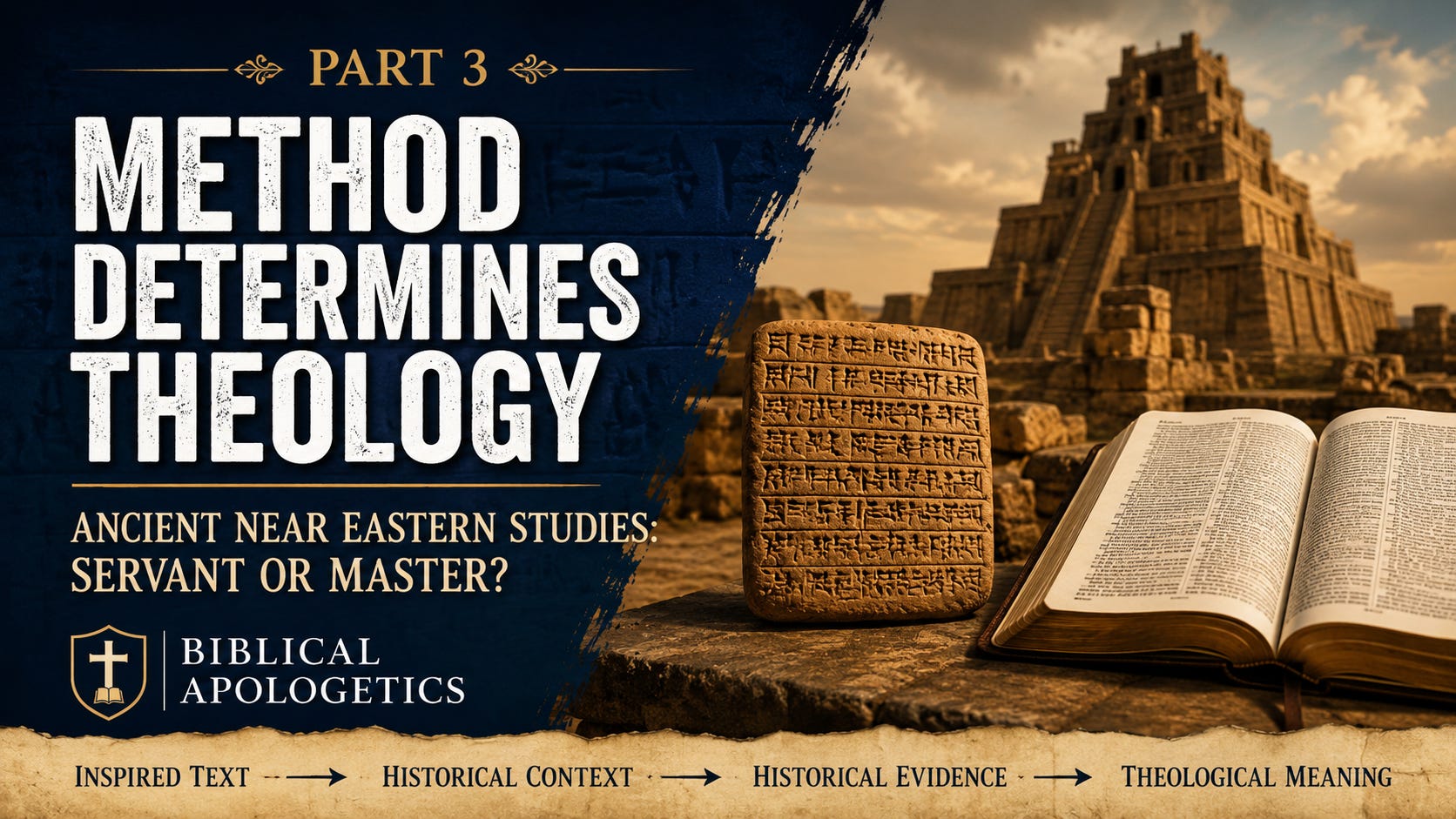
In Parts 1 and 2 of this series, we established two foundational truths. First, theology is ultimately shaped by hermeneutics. Every doctrinal conclusion rests upon a method of interpretation. Second, we traced the rise of historical criticism and observed how modern biblical scholarship gradually shifted its focus from the biblical text itself to historical reconstruction behind the text. While archaeology and Ancient Near Eastern (ANE) studies have unquestionably enriched our understanding of Scripture, the question before the church is no longer whether these disciplines are valuable. Rather, the question is whether they function as servants of exegesis or whether they have become masters over exegesis.
This distinction may appear subtle, but it reaches to the very heart of biblical authority. The issue is not whether Christians should study the ancient world. We should. God revealed Himself in history, and the Scriptures emerged within the cultures of Egypt, Canaan, Mesopotamia, Assyria, Babylon, Persia, Greece, and Rome. To ignore those historical settings is to ignore part of the context in which God chose to reveal Himself. Yet history itself is not inspired. Archaeology is not inspired. Comparative literature is not inspired. Scripture alone is “God-breathed” and therefore profitable “for teaching, for reproof, for correction, and for training in righteousness” so that the man of God may be complete, equipped for every good work (Second Timothy 3:16–17). Consequently, every historical discipline must remain subordinate to the inspired text.
This ordering has characterized faithful interpretation throughout church history. The Reformers affirmed Sola Scriptura not because they despised history but because they recognized that no human authority, whether ecclesiastical tradition, philosophical speculation, or historical reconstruction, possesses the authority of divine revelation. John Calvin regularly appealed to historical context, grammar, and geography, yet Scripture always remained the supreme authority. Likewise, the Protestant orthodox and later grammatical-historical interpreters consistently employed historical research without allowing it to redefine biblical meaning. Historical context illuminated the text; it did not govern the text.
Modern Ancient Near Eastern studies have often reversed that relationship.
One of the most influential voices in contemporary Old Testament scholarship is John Walton. Walton has repeatedly argued that “the Bible was written for us, but it was not written to us.” That observation, properly understood, is both true and helpful. Moses wrote to ancient Israel, not to twenty-first-century Americans. Paul wrote to first-century churches in Corinth, Ephesus, and Rome before his letters reached believers throughout the world. Every biblical author addressed a real historical audience living within a particular cultural environment. Ignoring that reality inevitably produces anachronistic interpretation.
The difficulty lies not in Walton’s observation but in what many interpreters conclude from it.
Some move from saying, “The Bible was written to an ancient audience,” to saying, “Therefore we must reconstruct the worldview of the Ancient Near East before we can know what Scripture means.” That conclusion does not necessarily follow. The original audience did not possess modern archaeological discoveries, cuneiform tablets, or comparative literary databases. What they possessed was the inspired text itself. They understood Moses because Moses wrote clearly enough for them to understand him. The same inspired text remains our primary source for understanding Moses today.
Historical background certainly assists interpretation. It helps explain vocabulary, customs, political realities, legal practices, architecture, agriculture, economics, and countless other details. Yet historical background does not replace the author’s own explanations. The inspired text always retains interpretive priority.
Consider the Tower of Babel in Genesis 11. Few conservative scholars deny that the tower likely resembled a Mesopotamian ziggurat. Archaeological discoveries demonstrate that such structures dominated the religious landscape of ancient Mesopotamia. These stepped temple towers functioned as sacred spaces associated with pagan worship. This historical information enriches our understanding of the passage.
The question, however, is what we do next.
Many contemporary scholars move from identifying the tower as a ziggurat to arguing that Genesis is fundamentally critiquing Mesopotamian temple ideology. Some suggest that the tower served as an “executive elevator” allowing deities to descend from heaven into their temples. Others conclude that Babel represents humanity’s attempt to domesticate God’s presence through pagan worship structures.
Such proposals may contain elements of historical plausibility. Yet one must ask an obvious question: Is this what Moses himself emphasizes?
The inspired narrative highlights something remarkably different. Humanity says, “Come, let us build ourselves a city and a tower with its top in the heavens, and let us make a name for ourselves, lest we be dispersed over the face of the whole earth” (Genesis 11:4). Moses identifies their motives explicitly: pride, self-exaltation, and rebellion against God’s command to fill the earth (Genesis 9:1, 7). God’s response likewise focuses upon their unified rebellion rather than their architectural techniques. He confuses their language and scatters them throughout the earth (Genesis 11:7–9). The theological emphasis comes from the inspired narrator, not from reconstructed Mesopotamian religion.
This illustrates an essential hermeneutical principle: historical parallels may illuminate the text, but they do not establish the text’s meaning.
The same principle applies to the flood narrative in Genesis 6–9. The discovery of the Atrahasis Epic and the Epic of Gilgamesh has generated enormous scholarly discussion because both contain flood traditions sharing certain similarities with Genesis. There is a righteous survivor. A vessel preserves life. Birds are released after the waters subside. Sacrifices follow the flood.
These similarities are genuine and worthy of study. They demonstrate that flood traditions circulated widely throughout the ancient world.
Yet similarity is not identity.
The theological differences are far more significant than the literary similarities. In Mesopotamian flood stories, the gods quarrel among themselves, act capriciously, fear the flood they unleash, and behave like morally flawed superhumans. In Genesis, the Lord judges humanity because “every intention of the thoughts of his heart was only evil continually” (Genesis 6:5). The flood arises from God’s perfect justice rather than divine irrationality. Noah survives by grace through faith (Genesis 6:8–9). God establishes an everlasting covenant after the flood (Genesis 9:8–17). The biblical narrative presents a morally perfect, sovereign Creator whose covenant faithfulness governs history.
The parallels therefore highlight the uniqueness of biblical theology rather than diminishing it.
Unfortunately, many modern scholars proceed differently. Rather than viewing Mesopotamian flood traditions as distorted memories of a historical catastrophe preserved among various peoples after Babel, they often conclude that Genesis simply adapted earlier pagan myths into Israel’s theology.
Notice the methodological assumption.
The existence of similarity becomes evidence of literary dependence.
Yet this conclusion is far from necessary. Similarity alone never proves borrowing. Two eyewitnesses describing the same historical event will naturally exhibit numerous similarities. Shared memory does not require literary dependence. Indeed, if Genesis records an actual historical flood from which all postdiluvian civilizations descend, one would expect flood traditions to appear throughout the ancient world, albeit corrupted through centuries of oral transmission.
Historical evidence can therefore support multiple explanations. The interpreter’s underlying methodology largely determines which explanation appears most persuasive.
The same issue arises in discussions of Genesis 1. Modern scholarship frequently compares the creation account with the Babylonian Enuma Elish. Similarities undoubtedly exist. Both discuss creation. Both speak of the heavens, the earth, and humanity. Yet the differences overwhelm the similarities. The Enuma Elish describes creation through violent conflict among rival deities. Humanity exists primarily to relieve the gods of labor. Genesis presents one sovereign Creator who speaks effortlessly into existence an orderly universe and creates humanity uniquely in His image to exercise righteous dominion over creation (Genesis 1:26–28).
Again, the biblical author does not borrow pagan theology. He demolishes it.
This pattern appears repeatedly throughout Scripture. Biblical revelation often enters the ancient world employing familiar vocabulary while radically redefining its meaning. Kingship, covenant, sacrifice, priesthood, temple, redemption, sonship, shepherd, and kingdom all possessed ancient cultural significance before God appropriated these concepts within His own revelation. The biblical writers do not simply mirror surrounding cultures; they transform cultural language through divine revelation.
Failure to recognize this distinction leads to one of the greatest dangers in contemporary biblical studies: allowing comparative evidence to become determinative rather than illustrative.
Richard Averbeck wisely observes that comparative studies should focus not merely upon similarities but also upon significant differences, for it is often the differences that reveal the distinctive theology of Israel’s Scriptures. Likewise, Gordon Wenham repeatedly warns that Genesis intentionally distinguishes itself from surrounding pagan literature through its theology of creation, covenant, and divine sovereignty. Kenneth Kitchen similarly argues that many alleged literary dependencies fail to satisfy historical standards of evidence and that similarities often reflect common ancient realities rather than direct borrowing.
This is precisely where methodology determines theology.
If the interpreter assumes Scripture is fundamentally one expression of Ancient Near Eastern religion, then similarities naturally become evidence of dependence. If, however, the interpreter begins with Scripture’s claim to divine inspiration, similarities may instead demonstrate God’s revelation entering a familiar historical world while correcting its theological errors.
Jesus Himself modeled this principle.
When challenged concerning marriage, He did not appeal to surrounding ancient customs. He appealed to Genesis itself: “Have you not read that He who created them from the beginning made them male and female?” (Matthew 19:4). His authority rested in the inspired text. Likewise, when tempted by Satan, Christ repeatedly answered, “It is written” (Matthew 4:4, 7, 10). The authority resided in God’s revealed Word.
The apostles followed the same pattern. Paul grounded his doctrine of justification in Genesis 15:6 (Romans 4:1–25; Galatians 3:6–14). The author of Hebrews interpreted Psalm 110 and Genesis 14 through canonical exposition rather than comparative religion (Hebrews 5–7). Peter explained Pentecost by appealing to Joel 2 (Acts 2:16–21). Throughout the New Testament, Scripture consistently interprets Scripture.
This does not minimize historical context. Instead, it establishes its proper place.
The faithful interpreter therefore proceeds in a deliberate order. Grammar comes first because meaning resides in language. Literary context follows because words derive meaning from their surrounding discourse. Historical setting illuminates how the original audience understood the author’s language. Canonical context demonstrates how God’s progressive revelation unfolds across Scripture. Only then should comparative Ancient Near Eastern material be employed to clarify, not redefine, the meaning already established by the inspired text.
This hierarchy preserves both intellectual honesty and biblical authority. It welcomes archaeology without surrendering to archaeology. It appreciates comparative literature without becoming captive to comparative literature. It studies history while remembering that history itself remains a fallible human discipline rather than inspired revelation.
Christians therefore need not fear Ancient Near Eastern studies. We should read them carefully, evaluate them critically, and employ them gratefully. Yet we must never confuse historical reconstruction with divine revelation. One rests upon provisional scholarly conclusions; the other rests upon the infallible Word of God.
Whenever external evidence begins to tell Scripture what it is allowed to mean, hermeneutics has already gone astray.
Historical background is a faithful servant of biblical interpretation.
It must never become its master.
Footnotes
1. John H. Walton, The Lost World of Genesis One (Downers Grove, Illinois: IVP Academic, 2009), 15–28.
2. Gordon J. Wenham, Genesis 1–15, Word Biblical Commentary (Dallas: Word Books, 1987), xxxv–l.
3. Richard E. Averbeck, “Reading Genesis 1–2 in Its Ancient Near Eastern Context,” in Reading Genesis 1–2: An Evangelical Conversation, edited by J. Daryl Charles (Peabody, Massachusetts: Hendrickson, 2013), 9–54.
4. Kenneth A. Kitchen, On the Reliability of the Old Testament (Grand Rapids: William B. Eerdmans Publishing Company, 2003), 421–454.
5. Victor P. Hamilton, The Book of Genesis: Chapters 1–17, New International Commentary on the Old Testament (Grand Rapids: William B. Eerdmans Publishing Company, 1990), 1–58.