Pattern Recognition and the Wisdom of God
Why Biblical Discernment Requires Observation, Investigation, and Humility

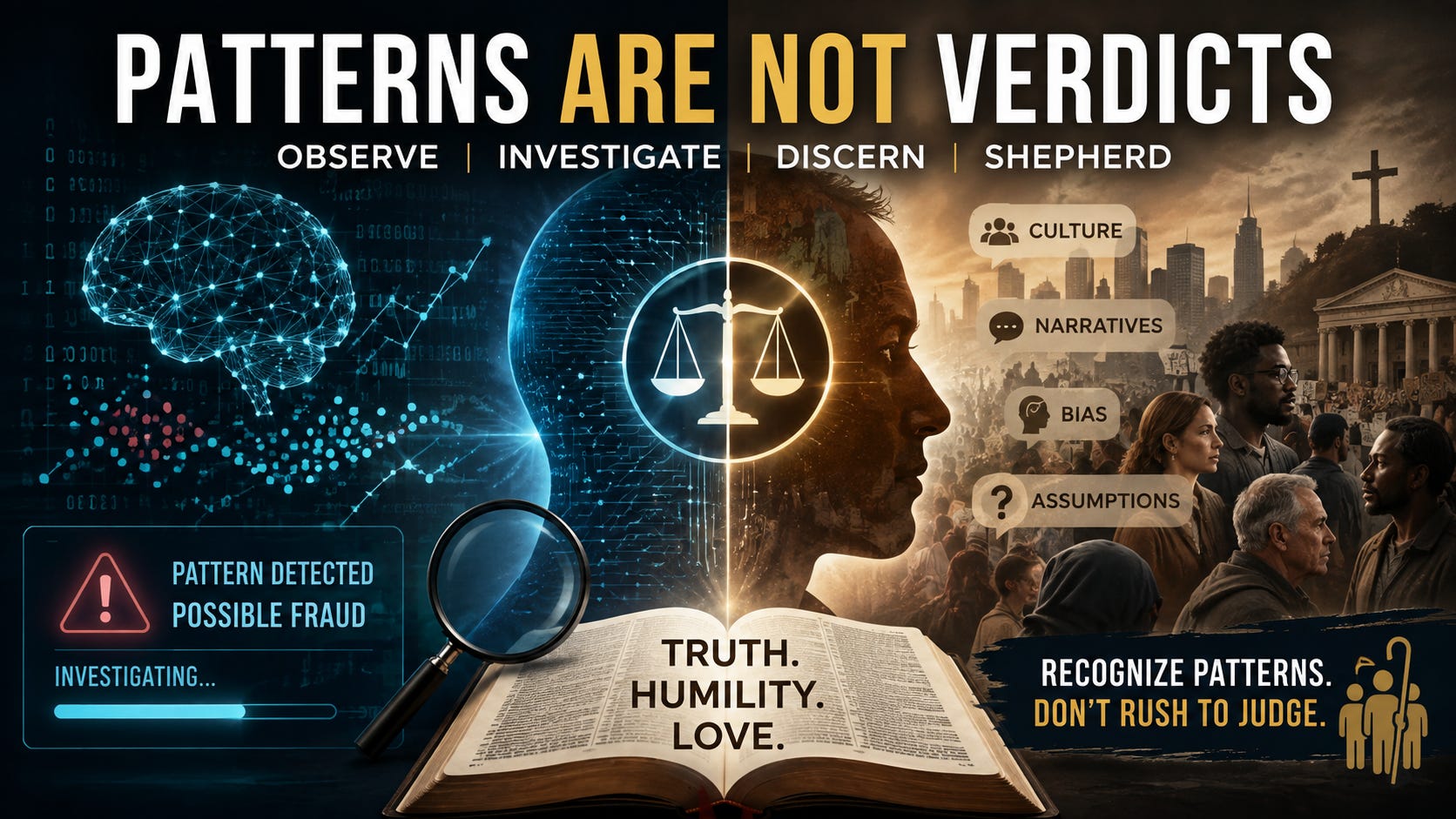
Modern artificial intelligence recognizes an important principle that Scripture revealed long ago: recognizing patterns is the beginning of wisdom, not the end of discernment.
When a bank’s artificial intelligence system flags a credit card transaction as possible fraud, something remarkable has happened. The system has not “caught a criminal.” Instead, it has recognized a pattern. Perhaps the card was used in Atlanta at 9:00 a.m. and then appears to make a purchase in Tokyo only thirty minutes later. Perhaps a customer who ordinarily purchases groceries, gasoline, and household supplies suddenly attempts to purchase $12,000 worth of luxury watches overseas. After comparing the transaction against millions of previous examples, the system concludes that the activity closely resembles known fraudulent behavior. Yet notice what happens next. A well-designed fraud detection system does not immediately accuse the customer of theft or permanently freeze the account. Instead, it begins another process. The customer receives a verification request. The account history is examined. Additional evidence is gathered. The customer’s identity is confirmed. Only after those steps does the institution determine whether fraud has actually occurred. Pattern recognition begins the investigation; it does not establish the verdict.
Modern computer science has, in many ways, rediscovered a principle that Scripture has taught for thousands of years. God created human beings to recognize patterns, but He never intended patterns to function as verdicts. Biblical wisdom begins with observation, proceeds through interpretation and careful investigation, and only then arrives at judgment. This distinction is becoming increasingly important in an age dominated by competing narratives about society, race, politics, economics, theology, and culture. Christians are often pressured toward one of two opposite errors. One side insists that recognizing patterns among people or institutions is inherently prejudicial and therefore morally suspect. The other assumes that once a pattern has been observed, its explanation has already been discovered and judgment may confidently follow. Scripture rejects both extremes. The wisdom of God neither ignores observable reality nor permits observation to substitute for careful investigation.
The reason Scripture can affirm pattern recognition is because it begins with God Himself. God is not merely the Creator of all things but the wise Governor of all things. He created an orderly universe governed by His providence rather than by randomness or chaos. Seasons follow predictable rhythms because He ordained them. Seeds reproduce according to their kinds because He established their order. Moral actions ordinarily produce corresponding consequences because He governs the world consistently. Human beings recognize recurring patterns because they bear the image of the God who established those patterns in the first place. Unlike human beings, however, God does not merely recognize patterns; He ordains history itself. What we observe imperfectly, He has sovereignly designed. Consequently, our ability to discern recurring realities is not autonomous but derivative. It is one of the many ways finite image bearers reflect the wisdom of their infinite Creator.
This understanding explains why the book of Proverbs repeatedly calls God’s people to become careful observers of God’s world. Solomon instructs the sluggard to “go to the ant” and become wise through observation in Proverbs 6:6–11. He later studies the neglected vineyard of the lazy man and derives enduring lessons concerning diligence, responsibility, and poverty in Proverbs 24:30–34. Neither passage depends upon mystical insight or secret revelation. Solomon simply observes the ordinary world and recognizes recurring relationships that God Himself has established. Wisdom begins by paying attention.
Pattern recognition, therefore, is not a modern invention. Every physician recognizes recurring symptoms associated with particular illnesses. Every engineer recognizes recurring structural failures. Every parent recognizes patterns developing within the character of a child. Every experienced pastor recognizes recurring signs of spiritual maturity or decline. To refuse to acknowledge genuine patterns is not an expression of humility. It is a refusal to use one of God’s ordinary means of acquiring wisdom.
Yet observation alone never produces wisdom. Patterns never interpret themselves. Every observation requires interpretation, and interpretation is where fallen human beings most often go astray. Scripture teaches that sin corrupts not only human behavior but also human reasoning. The Apostle Paul explains in Romans 1:18–32 that fallen humanity suppresses the truth in unrighteousness. Consequently, two people may observe the same facts while reaching radically different conclusions because the heart governs the mind. The greatest danger is therefore not merely failing to recognize patterns but interpreting them apart from God’s revelation.
Jesus illustrated this principle with remarkable clarity during His confrontation with the Pharisees and Sadducees. Rebuking their unbelief, He observed that they could accurately predict tomorrow’s weather by reading the appearance of the evening sky, yet they failed to discern “the signs of the times” in Matthew 16:1–4. Luke 12:54–57 records a similar rebuke. His argument deserves careful attention because it reveals something profound about biblical wisdom. Jesus does not criticize their ability to recognize weather patterns. On the contrary, He assumes that such reasoning is both normal and wise because God created an orderly universe. Their failure was not observational but interpretive. They possessed a far greater body of evidence than changing weather conditions. John the Baptist had announced the coming Messiah. The Scriptures had foretold His ministry. Christ’s miracles fulfilled prophetic expectations. His teaching carried divine authority. The evidence stood before them in overwhelming abundance, yet they refused to interpret it correctly because their hearts resisted the truth.
The force of Jesus’ rebuke is therefore deeper than many readers appreciate. He is effectively saying, “You correctly recognize the ordinary patterns embedded within creation because God governs the natural world consistently. Why then do you refuse to recognize the far clearer covenantal patterns that God has revealed through His Word?” The problem was never a lack of evidence. The problem was a refusal to interpret the evidence according to God’s revelation. The same miracles that led Peter to confess Jesus as the Christ led others to accuse Him of performing miracles by the power of Beelzebul. The evidence remained the same. The interpretations differed because sinful hearts refused to submit to God’s truth.
This reality introduces what may be called epistemological humility. Biblical wisdom recognizes that finite and fallen human beings can observe genuine patterns while misunderstanding their significance. The wise person therefore resists two temptations. He refuses to deny obvious realities out of fear of drawing conclusions, but he also refuses to elevate observations into unquestionable explanations. Wisdom acknowledges what is seen while remaining humble about what has not yet been proven. Observation is indispensable, but it is never infallible.
For this reason, Scripture repeatedly insists that interpretation must be tested through careful investigation before judgment is rendered. Nowhere is this principle more evident than in Israel’s judicial laws. The Mosaic Law consistently required multiple witnesses, diligent inquiry, impartial examination, and careful evaluation before any verdict could be pronounced. Whether the accusation concerned idolatry, criminal wrongdoing, or false testimony, God’s judges were forbidden to rely upon appearances alone. They were commanded to investigate thoroughly before reaching conclusions in Deuteronomy 13:12–18, Deuteronomy 17:2–7, and Deuteronomy 19:15–21 because justice belongs to the God who knows all things perfectly, while human judges know only in part.
The wisdom literature reinforces this judicial principle. Proverbs 18:17 declares, “The first to plead his case seems right, until another comes and examines him.” The proverb exposes a universal weakness of fallen humanity. First impressions often appear convincing. Compelling narratives frequently seem complete. Observable patterns can feel conclusive. Yet genuine wisdom refuses to confuse plausibility with proof. The wise person listens patiently, examines additional evidence, and welcomes correction before arriving at judgment. Observation gives rise to inquiry; inquiry leads toward truth.
Paul’s treatment of Crete provides another striking example of this biblical pattern. Writing to Titus, Paul quotes the Cretan poet Epimenides: “Cretans are always liars, evil beasts, lazy gluttons. This testimony is true” (Titus 1:12–13). Modern readers often stumble over this statement because they assume Paul is making an absolute claim about every individual Cretan. Yet the context demonstrates otherwise. If Paul believed every Cretan was incapable of truthfulness or moral transformation, he would not have left Titus in Crete to establish churches, appoint qualified Cretan elders, and shepherd Cretan believers (Titus 1:5–9). Paul’s point is not that every individual possesses every characteristic equally, but that Crete had developed a widely recognized cultural reputation that was sufficiently accurate to inform pastoral ministry.
Paul therefore models precisely the distinction that modern discussions often overlook. He recognizes a genuine cultural pattern without reducing individuals to that pattern. He acknowledges observable reality without abandoning biblical justice. He refuses both naïve denial and deterministic thinking. His recognition of a general tendency does not eliminate the need to evaluate each individual according to his own life and conduct. More importantly, Paul expects the gospel to transform precisely those people whose culture had become known for moral corruption. Grace does not ignore reality; it redeems people within reality.
This balance reflects the wisdom of God throughout Scripture. The prophets repeatedly describe recurring patterns of covenant unfaithfulness within Israel. Jesus speaks of “this evil generation” (Matthew 12:39; Matthew 16:4). Proverbs describes the recurring characteristics of the sluggard, the fool, the adulterer, and the scoffer. None of these descriptions eliminate individual responsibility or deny the possibility of repentance. Instead, they recognize that sin often produces identifiable patterns while insisting that every individual remains morally accountable before God. Biblical wisdom recognizes recurring tendencies. Biblical justice evaluates individuals. Biblical grace transforms both.
This framework has profound implications for pastoral ministry. Experienced shepherds inevitably recognize recurring patterns that often precede spiritual decline. Isolation from the body of Christ, neglect of Scripture, increasing bitterness, unresolved conflict, habitual secrecy, doctrinal instability, and persistent worldliness frequently signal deeper spiritual concerns. Years of faithful shepherding enable pastors to notice these recurring realities because God ordinarily governs both spiritual growth and spiritual decline according to recognizable principles.
Yet faithful shepherds never confuse observation with accusation. They understand that recurring patterns invite investigation rather than justify condemnation. A wise pastor asks questions before drawing conclusions. He listens before speaking. He gathers facts before confronting. He distinguishes between appearances and reality. His goal is not to win an argument but to restore a brother or sister in Christ. This approach reflects the spirit of Galatians 6:1 and 2 Timothy 2:24–26, where restoration, patience, and gentleness characterize faithful ministry. Pattern recognition therefore becomes the beginning of shepherding rather than the basis for suspicion.
The same principle extends beyond the pastorate into every sphere of Christian life. Parents recognize developing patterns within the hearts of their children. Elders recognize recurring challenges within a congregation. Employers recognize trends in employee performance. Friends notice changes that may indicate suffering, temptation, or discouragement. Mature believers become increasingly skilled at observing these realities because wisdom grows through experience. Yet Christian love refuses to transform observations into accusations without careful inquiry. Wisdom and love therefore work together rather than against one another.
This biblical framework also provides much-needed clarity for Christians attempting to think faithfully about contemporary cultural issues. Modern society frequently oscillates between two opposite errors. Some deny obvious patterns because they fear that acknowledging them will inevitably produce prejudice or injustice. Others observe genuine patterns and immediately assume that they have discovered their complete explanation. Both approaches fail because they separate what God has joined together.
The wisdom of God teaches believers neither to deny observable reality nor to treat observation as self-interpreting. Human beings are image bearers living in a fallen world of extraordinary complexity. Similar outward patterns may arise from very different causes. Personal choices, family structures, cultural influences, institutional incentives, economic conditions, spiritual realities, and God’s providence often intersect in ways that resist simplistic explanations. Consequently, biblical wisdom continually asks two questions. First, “What pattern do I genuinely observe?” Second, “What evidence demonstrates why this pattern exists?” The first question belongs to observation. The second belongs to investigation. Confusing the two produces poor reasoning and, eventually, injustice.
Perhaps this is why the Mosaic Law placed such extraordinary emphasis upon careful inquiry before rendering judgment. The greater the consequences attached to a verdict, the greater the responsibility to establish the facts carefully. God never encouraged His people to lower evidentiary standards because an accusation appeared emotionally compelling or culturally persuasive. Deuteronomy 13, Deuteronomy 17, and Deuteronomy 19 consistently require judges to investigate diligently before pronouncing judgment. Likewise, Proverbs 18:13 warns against answering a matter before hearing it, and Proverbs 18:17 reminds God’s people that every case deserves careful examination. Truth and justice demand patient investigation because human judges possess neither omniscience nor infallibility.
Ultimately, this entire discussion points beyond human wisdom to Jesus Christ Himself. Unlike every earthly judge, Christ possesses perfect knowledge. He never mistakes correlation for causation. He never misunderstands motives. He never requires additional witnesses because He knows every heart completely (John 2:24–25). Yet even during His earthly ministry He repeatedly modeled patient and righteous judgment. He questioned. He exposed evidence. He confronted hypocrisy. He distinguished appearance from reality. He refused superficial judgments, declaring, “Do not judge according to appearance, but judge with righteous judgment” (John 7:24). The perfectly wise Judge perfectly embodied the wisdom He commands His disciples to pursue.
One day Jesus Christ will judge the living and the dead in perfect righteousness because His knowledge is perfect (2 Timothy 4:1; Revelation 20:11–15). Until that day, His people are called to exercise humble, careful, biblical discernment rather than pretending to possess His omniscience. We recognize genuine patterns because God created an orderly world. We investigate those patterns because we are finite and fallen. We judge carefully because justice belongs to God. We shepherd lovingly because Christ has first shown mercy to us.
The opening illustration from artificial intelligence reminds us of an unexpected truth. Even sophisticated machine-learning systems understand a principle that many modern thinkers have forgotten. Pattern recognition is invaluable, but it is not infallible. It initiates investigation; it does not replace it. Scripture teaches the same principle with infinitely greater depth because it comes from the God who created both the orderly universe and the human mind. Wisdom observes. Discernment interprets. Justice investigates. Judgment evaluates. Love shepherds. This is not merely a helpful method of reasoning. It is the wisdom of God applied to every sphere of life.
The church does not need less discernment; she needs biblical discernment. God has not called His people to ignore observable realities, nor has He authorized them to pronounce judgments on the basis of observation alone. Wisdom recognizes patterns because God created an orderly world. Humility remembers that fallen minds can misinterpret those patterns. Justice patiently investigates before rendering conclusions. Love applies those conclusions for the good of others. Above all, Christians look to Jesus Christ, the perfectly wise Judge, whose judgments are never clouded by ignorance, prejudice, or incomplete evidence. As His people learn to think according to His wisdom, they become a church marked by truth without gullibility, conviction without arrogance, and discernment without injustice.
Pattern recognition is a gift from God to all empaths of faith, we see the ‘signs’ way ahead of everyone else, and put out warnings. We are the Watchmen on the wall.